Page 109 - Learn Woodworking

  1. Video: Router Bits for Beginners

    Video: Router Bits for Beginners

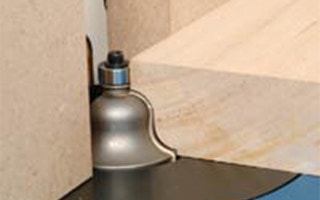
    In this video the most common types of router bits are explained for the novice woodworker. The Rockler router bits highlighted in this video include: Straight, Rabbeting, Round Over, Flush Trim, Roman Ogee, Chamfer, and Undersized Plywood Bits.
    Read more
  2. Power Planer or Jointer? Why Not Both?

    Power Planer or Jointer? Why Not Both?

    Modern power planers are equipped to plane and do many of the same tasks as a shop jointer, but with added portability outside your workshop. The worlds of woodworking and construction are similar but don’t always overlap. Tools used for one aren’t always suitable for the other. Some newer power planers, like this one from Porter-Cable, feature a switch that allows you to change the direction that chips and dust blow out.
    Read more
  3. Improve Your Workshop's Dust Control & Collection System

    Improve Your Workshop's Dust Control & Collection System

    Even if you can't develop an intricate dust collection system like this, there are many simple ways to improve your dust collector's output. Whether it’s a broom and dustpan or a state-of-the-art central collection system, every woodworker I know has some kind of strategy for dealing with wood waste in the shop. Of course, some of these methods produce better results than others in terms of fire safety, cleanliness and respiratory health.
    Read more
  4. Improve Your Bandsaw's Shop Production with Accessories

    Improve Your Bandsaw's Shop Production with Accessories

    This auxiliary table doubles the cutting surface of your bandsaw, with T-tracks to assist in setting up jigs and cutting guides. The common 14" band saw is one of the most versatile shop machines. You can crosscut and rip on it, do circles and complicated curves, even scrollwork with the right blade. It easily resaws expensive stock up to 6" wide and turns that waste into additional projects.
    Read more
  5. Sorting Through Sharpening Systems

    Sorting Through Sharpening Systems

    Keeping Tools Sharp - One Size Does Not Fit All How seriously should you take keeping your tools sharp? Ask around and you'll get a range of opinions. For some woodworkers, sharpening is at best a necessary evil - to be taken up only when a tool will no longer successfully cut wood. For others, the practice of keeping every chisel, plane iron, gouge, saw blade and pencil in the shop in absolute razor-sharp condition carries an almost spiritual significance. Most, however, would take a more moderate position.
    Read more

  6. Using a Combination Square for Measurements

    Using a Combination Square for Measurements

    The sort of combination square you have says a bit about you as a woodworker. The first one I used — for a couple of decades, at least — was a 1940s Craftsman I got from my dad. I used it for home improvement and construction projects and furniture-making work without much thought about its accuracy or about all the different uses I had for it.
    Read more
  7. The Value of Forstner Bits

    The Value of Forstner Bits

    Does every woodworker need a complete set of Forstner bits? In truth, many other less expensive bits - like brad point bits - will do a nice job in many situations. Keep in mind, though, that Forstner bits have a few qualities that make them indispensable in certain situations. You may be able to get by without a set of Forstner bits, but if you stick with woodworking for a few years, you'll probably end up with at least part of one - purchased one at a time out of sheer necessity. When you weigh the cost of individual bits against the much more friendly price per bit afforded by a complete set, the set starts to look like a bargain.
    Read more
  8. DIY Horizontal Benchtop Sander

    DIY Horizontal Benchtop Sander

    With things the way they are with the economy, more and more woodworkers are looking to get the most use out of the tools they already have, which is why I created this simple base fixture that transforms a standard portable belt sander into a small horizontal benchtop sander.
    Read more
  9. Router Table Basics - A Quick Tour of Router Table Techniques

    Router Table Basics - A Quick Tour of Router Table Techniques

    For as little as it takes to get set up, and the short time it takes to acquire skill at using a router table, it's easy to see why this venerable workhorse is often one of the first and most important tool purchases that a woodworker ever makes. Below, we'll take a quick look at the common woodworking procedures that you can master within the first few weeks of owning a router table, including:
    Read more
  10. Drilling Jigs for European Hinges

    Drilling Jigs for European Hinges

    When installing a European style hinge, drilling the hinge cup hole in the back of the cabinet door is the first and most crucial task. This sometimes puts people off. They imagine it has to be done with great precision and is therefore painstakingly difficult to achieve. They’re half right. Both the size and the placement of the hinge cup hole are extremely important to the end functioning of the hinge.
    Read more
  11. Understanding Right Angle Trigonometry

    Understanding Right Angle Trigonometry

    For a woodworker, being able to "solve" right triangles is an extremely important skill. Compound miters, multi-sided structures and a variety of other complex building projects can all be understood and calculated using right triangle trigonometry. If the term trigonometry causes you to suffer a sudden onset of "math anxiety," you'll be happy to know that the trigonometry you need for woodworking isn't all that complicated.
    Read more